If you’re considering solar energy, one of the most common questions is: do solar panels work on cloudy days?
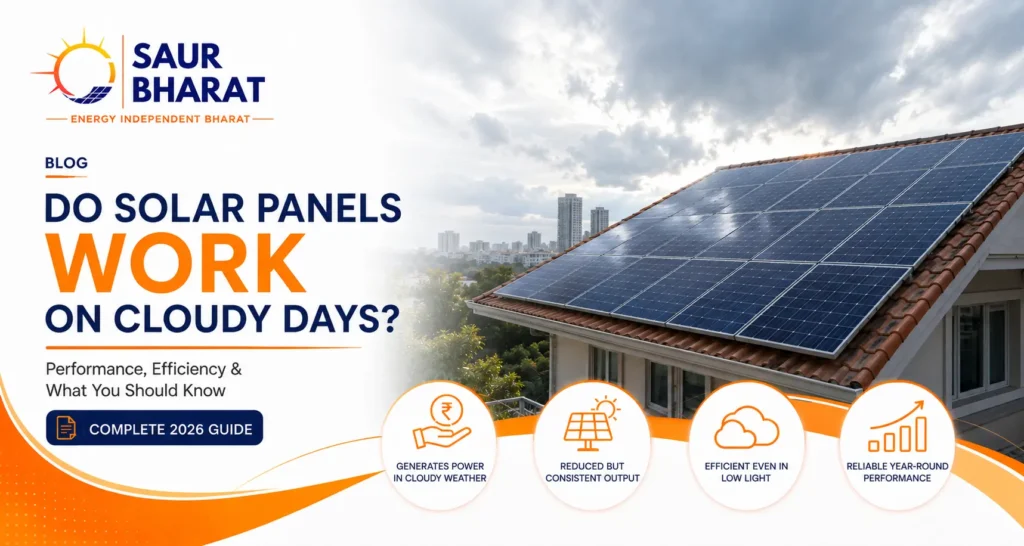
The short answer is yes, solar panels continue generating electricity even when the sky is cloudy. However, their output is lower compared to a bright sunny day.
This is especially important in India, where many homeowners worry about solar performance during the monsoon season. The good news is that modern solar panels are designed to capture both direct sunlight and diffused sunlight, allowing them to produce power even when clouds block the sun.
Let’s explore exactly how solar panels perform during cloudy weather, rain, and monsoons.
Do Solar Panels Work on Cloudy Days?
Yes. Solar panels typically generate 10% to 80% of their normal output during cloudy conditions depending on cloud density, panel technology, and system design.
Solar panels do not require direct sunshine to work. They use light particles (photons), which can still penetrate cloud cover.
Key Fact
Many countries with frequent cloud cover, such as Germany and the UK, are among the world’s leading solar energy adopters.
How Solar Panels Generate Electricity
Solar panels generate electricity from sunlight, not heat.
Photovoltaic (PV) cells convert sunlight into electrical energy through the photovoltaic effect.
This means:
✅ Sunny weather = Maximum production
✅ Cloudy weather = Reduced production
✅ Cool temperatures can actually improve efficiency
Many people assume solar panels need hot weather. In reality, excessive heat can slightly reduce panel efficiency.
How Well Do Solar Panels Work on Cloudy Days?
Most systems produce between 10% and 50% of normal output during heavy cloud cover.
Typical Solar Output
| Weather Condition | Expected Output |
| Clear Sunny Day | 100% |
| Light Clouds | 70–90% |
| Partly Cloudy | 50–80% |
| Overcast Sky | 20–50% |
| Heavy Storm Clouds | 10–30% |
Actual performance varies depending on:
- Solar panel quality
- Installation angle
- Geographic location
- Cloud thickness
- System maintenance
Do Solar Panels Generate Electricity on Cloudy Days?
Yes. Solar panels generate electricity using both direct and diffused sunlight.
Even when clouds block direct sunlight, scattered light reaches the solar cells.
This phenomenon is called diffuse solar radiation, and it allows solar panels on cloudy days to continue producing energy.
Does Solar Panel Work in Rainy Season?
Yes. Solar panels continue generating electricity during the rainy season, although production decreases.
Does Solar Panel Work in Rainy Season in India?
India’s monsoon season generally lasts from June to September.
During this period:
- Production may decline temporarily
- Cloud cover reduces sunlight intensity
- Rain naturally cleans solar panels
- Annual energy generation remains strong
Interestingly, rain often improves long-term performance by washing away:
- Dust
- Pollution
- Bird droppings
- Pollen
This natural cleaning can improve efficiency once sunny weather returns.
Cloudy Weather vs Heavy Rain: What’s the Difference?
Many people think cloudy weather and rainy weather have the same effect.
They don’t.
| Condition | Solar Performance |
| Light Cloud Cover | High |
| Partly Cloudy | Moderate to High |
| Overcast Conditions | Moderate |
| Heavy Rainfall | Low |
| Thunderstorms | Very Low |
The amount of available sunlight matters more than the rain itself.
Best Solar Panels for Cloudy Days
Monocrystalline panels generally perform best under low-light conditions.
Top Choices
1. Monocrystalline Panels
Benefits:
- Higher efficiency
- Better low-light performance
- Longer lifespan
2. TOPCon Solar Panels
Benefits:
- Improved energy yield
- Better cloudy-day performance
- Higher efficiency ratings
3. Bifacial Solar Panels
Benefits:
- Capture reflected light
- Improve energy generation
- Useful in open spaces
For Indian homes, high-quality monocrystalline TOPCon panels are often the best choice.
Do Solar Generators Work on Cloudy Days?
Yes, but charging is slower.
A solar generator uses solar panels to charge an internal battery.
During cloudy weather:
- Charging still occurs
- Charging speed decreases
- Larger panel arrays perform better
This is why battery storage becomes important for backup power.
Solar Production During Indian Monsoons
Regional Performance Overview
| Region | Cloud Impact |
| Rajasthan | Low |
| Gujarat | Low |
| Maharashtra | Moderate |
| Karnataka | Moderate |
| Kerala | High |
| Northeast India | High |
Even in regions with significant monsoon rainfall, annual solar generation remains attractive because India receives abundant sunlight throughout the year.
According to India’s solar resource assessments, most regions receive sufficient annual solar irradiation to support rooftop solar adoption.
How Battery Storage Helps on Cloudy Days
Battery systems store excess solar energy generated during sunny periods.
Benefits include:
- Backup power during cloudy weather
- Reduced grid dependence
- Better self-consumption
- Improved energy security
A battery can significantly improve the overall reliability of a rooftop solar system.
Common Myths About Solar Panels and Clouds
Myth #1: Solar Panels Stop Working on Cloudy Days
False.
They continue producing electricity using diffused sunlight.
Myth #2: Solar Needs Hot Weather
False.
Solar panels need sunlight, not heat.
Myth #3: Rain Damages Solar Panels
False.
Modern solar panels are designed to withstand rain, storms, and harsh weather.
Myth #4: Solar Is Not Suitable for Monsoon Regions
False.
Millions of solar installations worldwide operate successfully in cloudy climates.
How to Maximize Solar Output During Cloudy Weather
1. Choose High-Efficiency Panels
Monocrystalline TOPCon panels perform better in low-light conditions.
2. Avoid Shading
Trees, buildings, and water tanks can worsen cloudy-day performance.
3. Install Battery Storage
Store excess daytime generation.
4. Maintain Clean Panels
Dust and dirt reduce energy production.
5. Use Professional System Design
Proper tilt angle and orientation improve annual generation.
Is Solar Still Worth It in Cloudy Regions?
Yes.
Solar systems are designed based on annual energy production, not daily weather conditions.
Even if some days are cloudy:
- Sunny days compensate for lower production
- Net metering can offset grid consumption
- Long-term savings remain attractive
For most Indian homeowners, solar remains a financially sound investment despite seasonal cloud cover.
Also read: How to Calculate Solar Payback Period?
Key Takeaways
- Do solar panels work on cloudy days? Yes.
- Solar panels generate electricity using both direct and diffused sunlight.
- Cloud cover reduces output but does not stop generation.
- Monocrystalline and TOPCon panels perform best in low-light conditions.
- Solar panels continue working during India’s rainy season.
- Battery storage improves reliability during cloudy weather.
- Solar remains a cost-effective investment across most parts of India.
If you’re wondering whether solar panels on cloudy days can still save money, the answer is yes. Modern solar technology is specifically designed to deliver reliable annual energy production despite changing weather conditions.
Frequently Asked Questions (FAQ’s)
Do solar panels work in cloudy weather?
Yes. Solar panels continue generating electricity using diffused sunlight, although output is lower than on sunny days.
Will solar panels charge on a cloudy day?
Yes. Charging occurs more slowly, but solar panels still produce electricity.
Does solar panel work during rainy season?
Yes. Solar panels continue operating during rain and monsoon conditions.
How much power do solar panels produce on cloudy days?
Typically between 10% and 80% of normal production depending on cloud density.
Which solar panels work best on cloudy days?
Monocrystalline and TOPCon solar panels generally perform best under low-light conditions.
Do solar generators work on cloudy days?
Yes. Solar generators can still charge during cloudy weather, but charging speeds are reduced.
Can solar panels work without direct sunlight?
Yes. Diffused sunlight is enough to generate electricity.
Is solar worth installing in monsoon-prone areas?
Yes. Annual energy production remains strong despite seasonal cloud cover.