If you’re planning to install solar panels, one question comes up first:
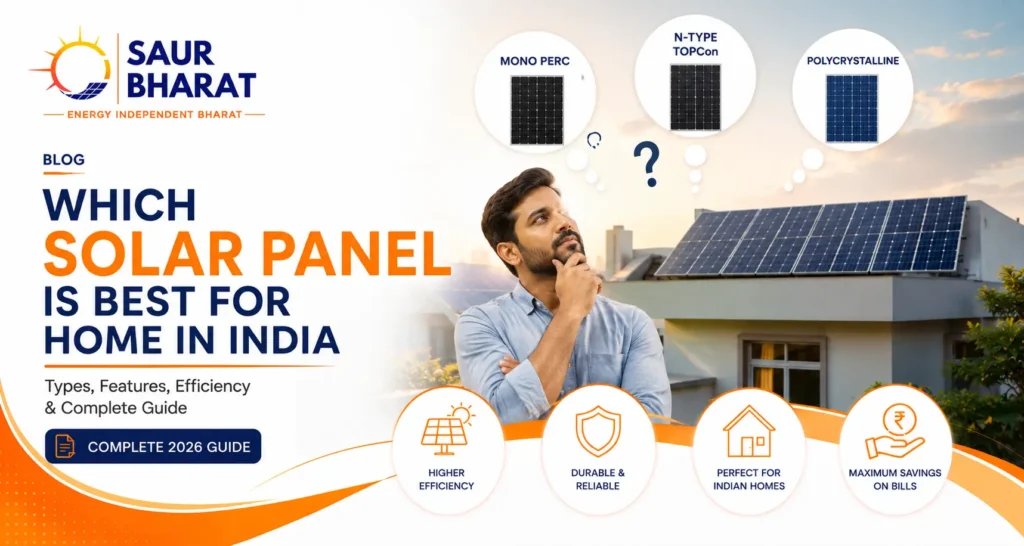
Which solar panel is best for home use in India?
The short answer is:
N-Type TOPCon monocrystalline solar panels are currently the best solar panels for most Indian homes because they offer higher efficiency, lower degradation, better performance in hot weather, and longer energy production over their lifetime.
However, the right choice also depends on your budget, roof size, electricity bill, and future energy needs.
This guide will help you choose the best solar power system for home use with practical recommendations rather than marketing claims.
What Is the Best Solar Panel for Home?
For most homeowners in India:
| Requirement | Recommended Panel |
| Highest efficiency | N-Type TOPCon |
| Best value for money | Mono PERC |
| Maximum energy generation | Bifacial TOPCon |
| Small roof area | High-efficiency TOPCon |
| Budget installation | Mono PERC |
| Long-term investment | N-Type TOPCon |
If your roof has limited space, TOPCon panels are usually the best choice because they generate more electricity from the same area.
Types of Solar Panels Explained
1. Monocrystalline Solar Panels
Monocrystalline panels are made from a single silicon crystal.
Benefits:
- Higher efficiency
- Better appearance
- Longer lifespan
- Better low-light performance
Typical efficiency:
19%–23%
These are currently the most popular solar panels for homes in India.
2. Polycrystalline Solar Panels
Polycrystalline panels use multiple silicon crystals.
Benefits:
- Lower upfront cost
Limitations:
- Lower efficiency
- Requires more roof space
- Gradually becoming less common
Typical efficiency:
15%–18%
For most new installations, Mono PERC or TOPCon panels provide better long-term value.
3. N-Type TOPCon Solar Panels
TOPCon stands for:
Tunnel Oxide Passivated Contact
This is one of the most advanced commercially available solar technologies.
Advantages:
- Higher efficiency
- Lower annual degradation
- Better temperature performance
- Higher energy yield
- Longer useful life
Typical efficiency:
22%–24%
Many experts consider TOPCon the best household solar panels available today.
4. Bifacial Solar Panels
Bifacial panels generate electricity from both sides.
Benefits:
- Increased energy production
- Better performance on reflective surfaces
- Suitable for elevated structures
Additional energy generation:
5%–20% more than conventional panels
Mono PERC vs TOPCon vs Bifacial Solar Panels
| Feature | Mono PERC | TOPCon | Bifacial TOPCon |
| Efficiency | High | Very High | Very High |
| Cost | Moderate | Higher | Highest |
| Lifespan | 25 Years | 30+ Years | 30+ Years |
| Degradation | Moderate | Low | Low |
| Heat Performance | Good | Excellent | Excellent |
| Roof Space Requirement | Moderate | Low | Low |
| Best For | Budget-conscious homes | Most homeowners | Premium projects |
Winner
For most Indian homes:
TOPCon panels provide the best balance of efficiency, durability, and lifetime energy generation.
Solar Panel Efficiency Comparison
What Is Solar Panel Efficiency?
Solar panel efficiency measures how much sunlight a panel converts into electricity.
Higher efficiency means:
- More electricity
- Less roof space required
- Better long-term savings
| Technology | Efficiency Range |
| Polycrystalline | 15%–18% |
| Mono PERC | 19%–22% |
| TOPCon | 22%–24% |
| HJT (Heterojunction) | 23%–25% |
The highest efficient solar panels available commercially today generally use TOPCon or HJT technology.
Best Solar Panel for Different Types of Homes
For Small Rooftops
Choose:
N-Type TOPCon
Reason:
Maximum energy from limited roof area.
For Large Independent Houses
Choose:
Bifacial TOPCon
Reason:
Higher lifetime electricity production.
For Budget-Conscious Families
Choose:
Mono PERC
Reason:
Excellent balance between cost and performance.
For High Electricity Bills
Choose:
TOPCon Solar Panels + Net Metering
Reason:
Maximum savings and faster return on investment.
Best Solar Panel Brands in India
Some of the top-rated solar panel manufacturers available in India include:
- Tata Power Solar
- Waaree Energies
- Adani Solar
- Vikram Solar
- RenewSys
- Goldi Solar
- Saatvik Solar
- Rayzon Solar
When comparing brands, focus on:
- Efficiency
- Product warranty
- Performance warranty
- Service support
- Certifications
Rather than brand alone.
How Much Do Solar Panels Cost in India?
Approximate solar panel price ranges:
| Technology | Approximate Panel Cost |
| Polycrystalline | Lowest |
| Mono PERC | Medium |
| TOPCon | Medium-High |
| Bifacial TOPCon | High |
For complete rooftop systems:
| System Size | Typical Home Use |
| 1 kW | Small home |
| 2 kW | Small family |
| 3 kW | Average household |
| 5 kW | Medium-large family |
| 10 kW | Large home |
Government subsidy programs can significantly reduce installation costs.
For the latest subsidy details, homeowners can refer to:
https://pmsuryaghar.gov.in
How to Choose the Best Solar System for Home
Step 1: Check Monthly Electricity Consumption
Look at your last 12 months of electricity bills.
Step 2: Measure Available Roof Space
Typical requirement:
- 1 kW = 80–100 sq. ft.
Step 3: Select High-Efficiency Panels
Especially if roof space is limited.
Step 4: Compare Warranties
Look for:
- Product Warranty: 12–30 years
- Performance Warranty: 25–30 years
Step 5: Work with an Independent Solar Consultant
Independent consultants help homeowners compare technologies objectively rather than promoting a specific brand.
Common Mistakes When Buying Solar Panels
Choosing Only Based on Price
The cheapest panel often produces less electricity over its lifetime.
Ignoring Degradation Rates
A panel losing 0.4% annually performs better over decades than one degrading at 0.7%.
Oversizing or Undersizing the System
Proper system sizing is critical for maximizing return on investment.
Ignoring Warranty Terms
Not all warranties provide the same level of protection.
Expert Recommendation from Saur Bharat
At Saur Bharat, our recommendation for most Indian homeowners is:
“If your budget allows, choose N-Type TOPCon solar panels. Their higher efficiency, lower degradation, and better heat performance make them the most future-ready solar technology for residential installations in India.”
For homeowners focused on affordability, Mono PERC remains an excellent option.
The best solar panel is not necessarily the most expensive one – it is the panel that delivers the highest lifetime value for your specific home.
Conclusion
So, which solar panel is best for home use in India?
For most homeowners, N-Type TOPCon solar panels are currently the best solar panels for home installations due to their superior efficiency, longer lifespan, lower degradation, and better performance in India’s hot climate.
If budget is your primary concern, Mono PERC panels continue to offer excellent value.
Before investing, evaluate your electricity usage, roof space, warranty coverage, and long-term energy goals. Choosing the right solar panel today can provide clean solar electricity for your home for the next 25 to 30 years.
Frequently Asked Questions
Which solar panel is best for home use in India?
N-Type TOPCon solar panels are currently considered the best option for most Indian homes due to high efficiency, low degradation, and better heat performance.
Which type of solar panel is best for home use?
Monocrystalline solar panels, especially TOPCon variants, are generally the best choice for residential installations.
What are the highest efficient solar panels available today?
HJT and TOPCon solar panels currently offer the highest commercial efficiencies, typically between 22% and 25%.
Are TOPCon panels worth the extra cost?
Yes. Their higher energy production and lower degradation often result in better lifetime savings.
How long do solar panels last?
Most quality solar panels last 25–30 years or more with proper installation and maintenance.
Which solar panel brand is best in India?
Popular options include Tata Power Solar, Waaree, Adani Solar, Vikram Solar, Goldi Solar, and RenewSys.
How much roof space is required for a 3 kW solar system?
A 3 kW rooftop solar system generally requires around 240–300 square feet of shadow-free roof area.